How to Change MAC Address on Mac: Step-by-Step Guide
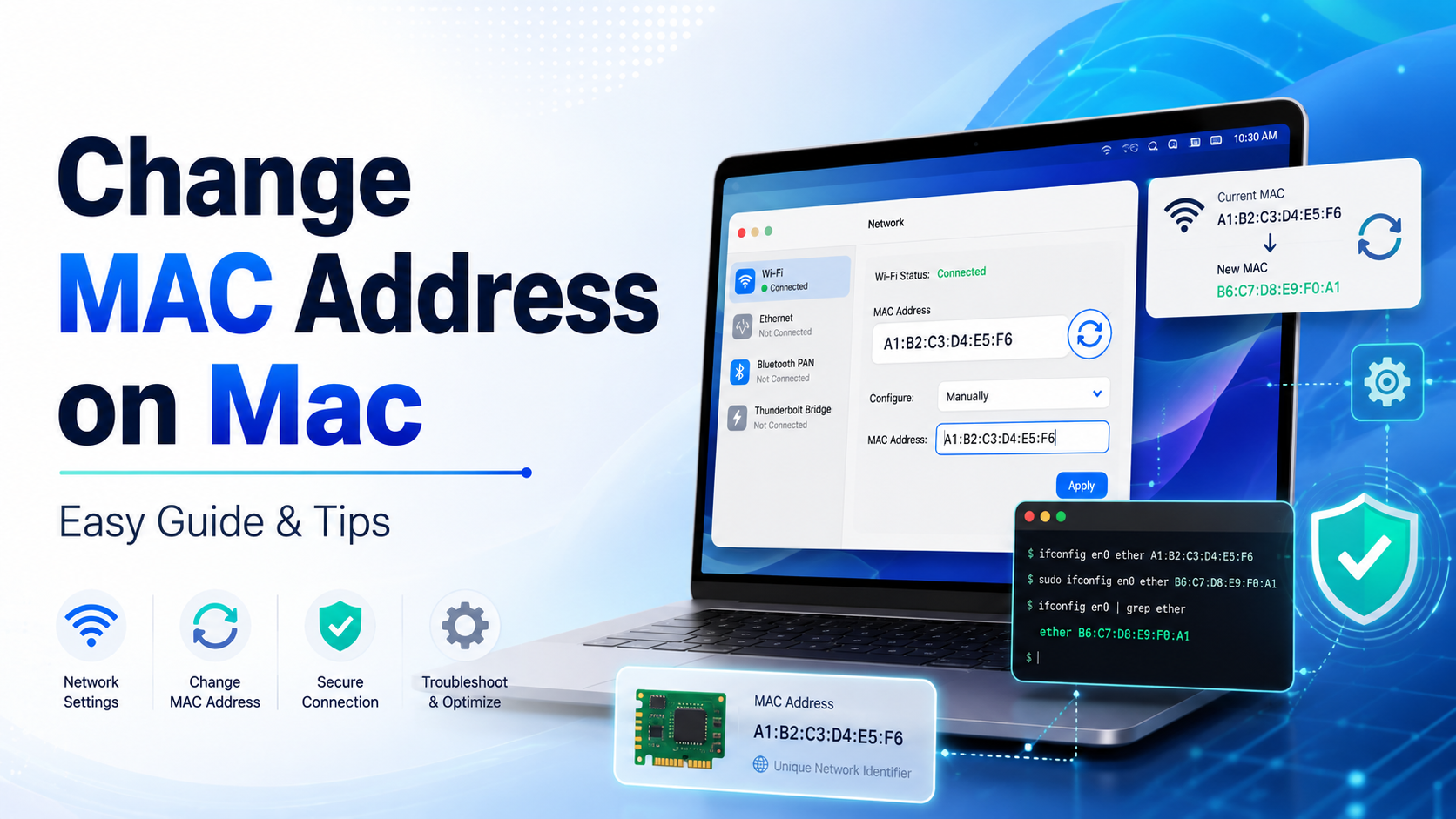

How to Change MAC Address on Mac: Complete Privacy Guide
In today's hyper-connected world, protecting your digital identity has never been more important. Every time your Mac connects to a network, it broadcasts a unique hardware identifier that can be logged, tracked, and used to build a profile of your behavior. If you've ever wondered how to change MAC address on Mac, you're not alone — it's one of the most practical privacy moves you can make as a modern computer user.
Whether your goal is to enhance anonymity, bypass restrictive public Wi-Fi timers, or troubleshoot a stubborn network issue, this step-by-step guide covers everything you need to know — from the basics to advanced Terminal commands.

Understanding MAC Addresses
Before diving into the how-to, it helps to understand what a MAC address actually is. MAC stands for Media Access Control. It's a 12-character alphanumeric identifier — looking something like f4:0f:24:1a:2b:3c — that is permanently assigned to your device's network interface controller (NIC) by the manufacturer.
MAC Address vs. IP Address: Key Differences
It's easy to confuse a MAC address with an IP address, but they serve completely different purposes. Your MAC address functions like a hardware serial number — it identifies your specific device on the local network. Your router uses it to direct packets to your laptop rather than your phone. Your IP address, on the other hand, acts like a mailing address. It's assigned by your router or ISP and changes depending on the network you join.
The critical distinction: your MAC address doesn't change when you move between networks. This static nature is precisely why so many privacy-conscious users want to learn how to modify it.
Why Your MAC Address Matters for Privacy
Every Wi-Fi network you connect to logs your MAC address. Retailers, shopping centers, and marketing firms routinely use these logs to track your physical movement patterns across different locations over time. If you use the same MAC address everywhere, it becomes a persistent fingerprint tied to your device — not just your account. Just as you might run a browser fingerprint test to see what data your browser exposes, checking and changing your MAC address is another layer of proactive privacy hygiene.
Why Change Your MAC Address? Key Reasons
There are several legitimate, security-focused reasons why people choose to spoof or rotate their MAC address. Here are the most common ones.
1. Boost Your Digital Privacy
Network administrators on public Wi-Fi can log which devices connect and for how long. By randomizing your MAC address before connecting, you appear as a new, anonymous device each time. This prevents third parties from building long-term behavioral profiles based on your network activity. For anyone serious about online privacy, this pairs naturally with a broader secure browser guide approach to reducing your digital footprint.
2. Bypass Public Wi-Fi Time Limits
Many hotels, airports, and cafes offer complimentary Wi-Fi for 30 to 60 minutes, after which access is blocked based on your hardware ID. By generating a new MAC address, the router recognizes your device as brand new — effectively resetting your free session. This is one of the most popular practical use cases for MAC spoofing.

3. Fix Network Authentication Issues
If your router's DHCP table gets corrupted, it may refuse to assign your device a valid IP address. Changing your MAC address forces the router to treat your Mac as a completely new client, often resolving stubborn connectivity errors without needing to restart the whole network. This is especially useful in office environments where rebooting the router isn't an option.
Preparation: Finding Your Current MAC Address
Before making any changes, write down your original MAC address. You'll need it to verify the change worked — and to revert back if needed.
Method 1: Via System Settings
This is the easiest approach for most users:
- Click the Apple logo in the top-left corner and select System Settings.
- Click Network in the sidebar.
- Select your active connection (usually Wi-Fi) and click Details or Advanced.
- Look for the Wi-Fi MAC Address field — it will display a string like f4:0f:24:1a:2b:3c.
Method 2: Via Terminal
For a faster, one-line approach, open Terminal (Applications → Utilities) and run:
ifconfig en0 | grep ether
This returns your current MAC address for the en0 interface (your primary Wi-Fi adapter). Write down the output before proceeding.

Important Note for Apple Silicon Mac Users
If you're running an M1, M2, or M3 Mac, be aware of an important hardware limitation. Apple has hardcoded certain network security protocols into the Wi-Fi architecture of these chips. If you attempt to spoof your Wi-Fi interface using a completely random address that doesn't follow Apple's OUI (Organizationally Unique Identifier) prefix format, your Mac may reject the change — and your Wi-Fi may refuse to turn on until you revert it.
Pro Tip for Apple Silicon users: Either use a third-party USB Wi-Fi adapter, or use a spoofing tool that automatically generates addresses with valid Apple OUI prefixes (the first 6 hex characters). This avoids the hardware rejection issue entirely.
Step-by-Step: How to Change Your MAC Address via Terminal
This method uses only built-in macOS tools — no additional software required. Follow each step carefully.
Step 1: Disconnect from Your Current Network
Your Wi-Fi card must be disconnected from an active network before you apply the change, but the Wi-Fi hardware itself must remain enabled. Hold Option, click the Wi-Fi icon in your menu bar, and select Disconnect from your current network.
Step 2: Generate a Random MAC Address
In Terminal, run the following command to generate a properly formatted random address:
openssl rand -hex 6 | sed 's/..../&:/g;s/:$//'
Copy the output (e.g., 1a:2b:3c:4d:5e:6f). You'll use this in the next step.
Step 3: Apply the New MAC Address
Run the following command, replacing [NEW MAC ADDRESS] with the string you just generated. You'll be prompted for your Mac login password — type it and press Enter:
sudo ifconfig en0 ether [NEW MAC ADDRESS]
Step 4: Reconnect and Verify
Click the Wi-Fi icon and reconnect to your desired network. Then run the verification command again:
ifconfig en0 | grep ether
If the output shows your new address instead of the original, the spoof was successful. Never skip this verification step — it only takes a few seconds and confirms the command worked.
Alternative: Third-Party MAC Spoofing Tools
Not everyone is comfortable with the command line, and that's perfectly fine. Several well-regarded third-party macOS apps — such as WiFiSpoof — provide a graphical interface for changing your hardware ID with a single click. These tools often include built-in randomization engines, the ability to save multiple MAC profiles, and automatic Apple Silicon compatibility handling.
For users managing multiple online accounts, browser profiles, or automated workflows, Hidemium takes privacy further by isolating browser fingerprints, cookies, proxies, and login environments across separate profiles. This makes full-stack identity separation easy to manage — going well beyond what MAC-level changes alone can achieve.

How to Revert Your MAC Address
A spoofed MAC address on macOS is always temporary. The change lives only in your system's volatile memory, so the simplest way to restore your original address is to restart your Mac. On reboot, macOS clears the temporary network configuration and pulls the original hardware identifier directly from the physical NIC.
If restarting isn't an option, manually revert in Terminal by running the same command with your original address:
sudo ifconfig en0 ether [YOUR_ORIGINAL_MAC]
If your network settings become severely corrupted, navigate to System Settings → Network, delete the Wi-Fi connection entirely, restart your Mac, and re-add Wi-Fi as a fresh connection to reset everything to defaults.
Frequently Asked Questions
Can I change the MAC address on a wired Ethernet connection?
Yes. The process is identical, but you target a different interface. Instead of en0 (Wi-Fi), use your Ethernet interface — typically en1 or en2. Run networksetup -listallhardwareports in Terminal to see the exact name for your Ethernet port.
Is MAC address spoofing legal?
In most jurisdictions, yes. Changing your own device's hardware identifier is a recognized legitimate privacy practice. However, using MAC spoofing to bypass security bans on corporate networks, commit fraud, or engage in malicious activity is illegal. Use this knowledge responsibly.
Will changing my MAC address hide my browsing from my ISP?
No. Your MAC address only governs local network communication — between your device and the router. Once data leaves the router and reaches the internet, your IP address takes over. To hide traffic from your ISP, you need a VPN in addition to MAC-level privacy measures.
Conclusion
Learning how to change your MAC address on Mac is one of the most practical, low-effort ways to strengthen your network privacy. Whether you're preventing retail tracking systems from logging your movements, bypassing a frustrating airport Wi-Fi timer, or fixing a local network glitch, a few Terminal commands give you complete control over how your hardware is identified.
Always follow the golden rule: write down your original address before making changes, verify the new address was applied, and remember that a simple restart will always restore your default identity. Pair this with broader digital hygiene practices for a significantly stronger overall privacy posture.
Related Blogs

Have you ever needed to access TikTok but didn’t have your phone nearby? I’ve been there too – when my phone ran out of battery or I just wanted to see notifications on the big screen without distraction. That’s when,TikTok Web becomes a great choice, bringing a smooth and surprisingly convenient experience.With TikTok Web, you can easily do a lot of things: from browsing your For You Page,[…]

In the fast-paced world of social commerce, AI UGC Video Generator tools have become game-changers for brands and creators who need scroll-stopping content without the hassle of traditional shoots. These platforms let you turn product images or simple prompts into realistic user-generated-style videos in minutes.I spent weeks testing popular options—uploading products, tweaking scripts, and even[…]

In the SEO space, many businesses and agencies build blogging strategies from scratch, focusing on optimizing website rankings through quality content. However, a common challenge is Manage multiple Ahrefs accounts for multiple clients or share access that no additional user fees for Ahrefs.Hidemium who share how Share Ahrefs account safely, comply with terms and avoid the risk of being locked[…]
.png)
How to Get Social Media Help: Tips, Tools, and Resources That Actually WorkWhether you're locked out of your account, dealing with a sudden algorithm change, or trying to protect your digital footprint, navigating social media platforms can feel like a full-time job. Fortunately, social media help is well within reach — if you know exactly where to look and what strategies to apply.Platforms like[…]
Google Chrome is a popular browser but not the best choice when you need Manage Multiple X Accounts (Twitter) at the same time. In this article, we will explore the limitations of Chrome, the role of browser fingerprint, and why antidetect browser Hidemium is a superior solution for creating and operating multiple secure accounts.1. Is it possible to create multiple X accounts on[…]

Do you want your social media content to make users stop, read, and react? If so, the right rephrasing can surely help you to achieve that. But the question is, what exactly do you need to do to paraphrase your posts so they become more engaging? Well, if you have no idea, this guide is a must-read for you. In this article, we’ll share some of the most effective tips to turn your boring and dull[…]
