
Title:
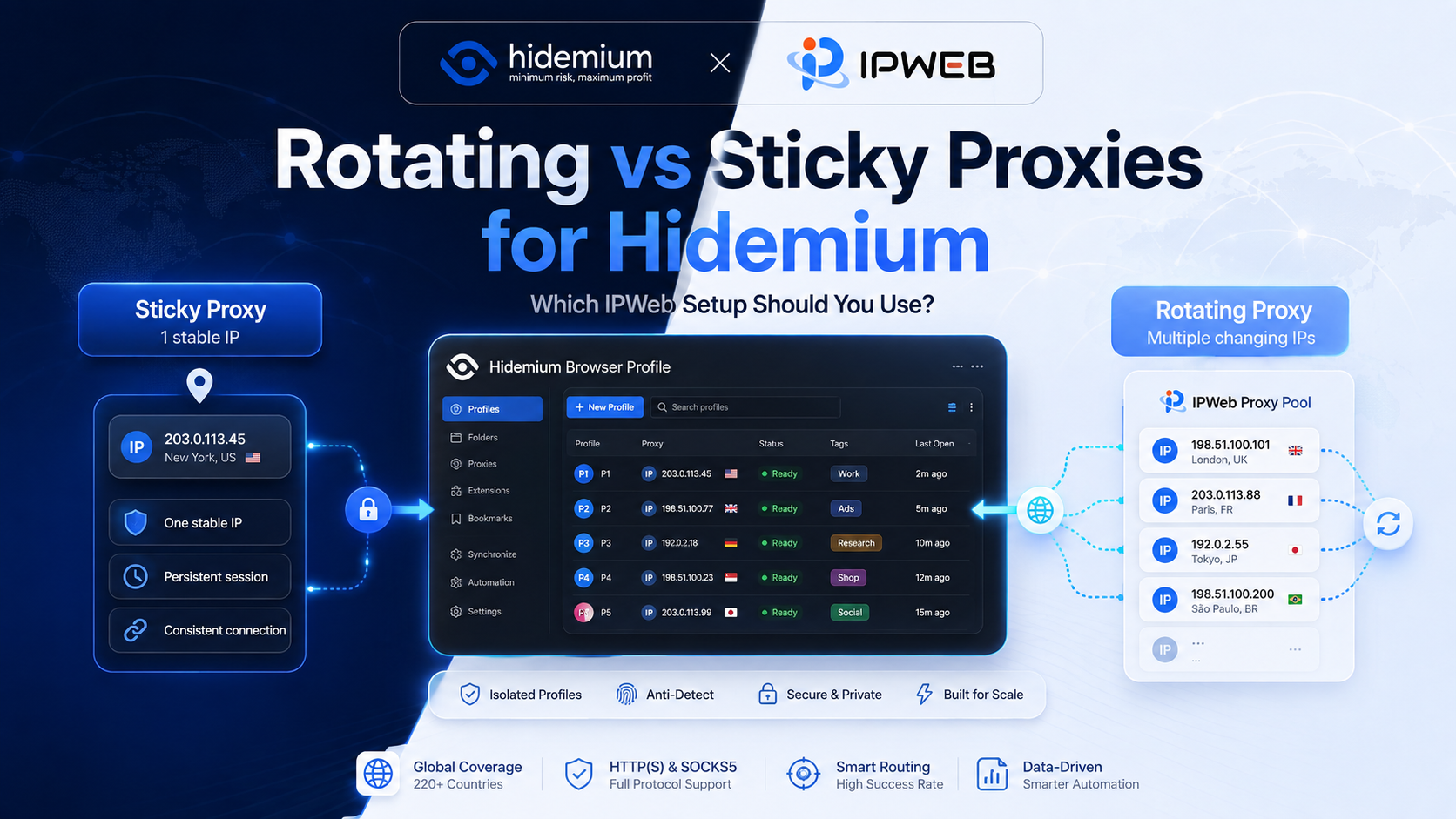
Rotating vs Sticky Proxies for Hidemium: Which IPWeb Setup Should You Use?
Meta description:
Rotating or sticky proxy for Hidemium? Compare both IPWeb proxy setups, see which works best for stable sessions, research, geo testing and browser profiles.
Rotating vs Sticky Proxies in Hidemium: Which IPWeb Proxy Setup Is Right for You?
If you're using IPWeb proxies with Hidemium Antidetect Browser, one of the first decisions is whether your browser profile should use a sticky proxy or a rotating proxy.
The difference is simple:
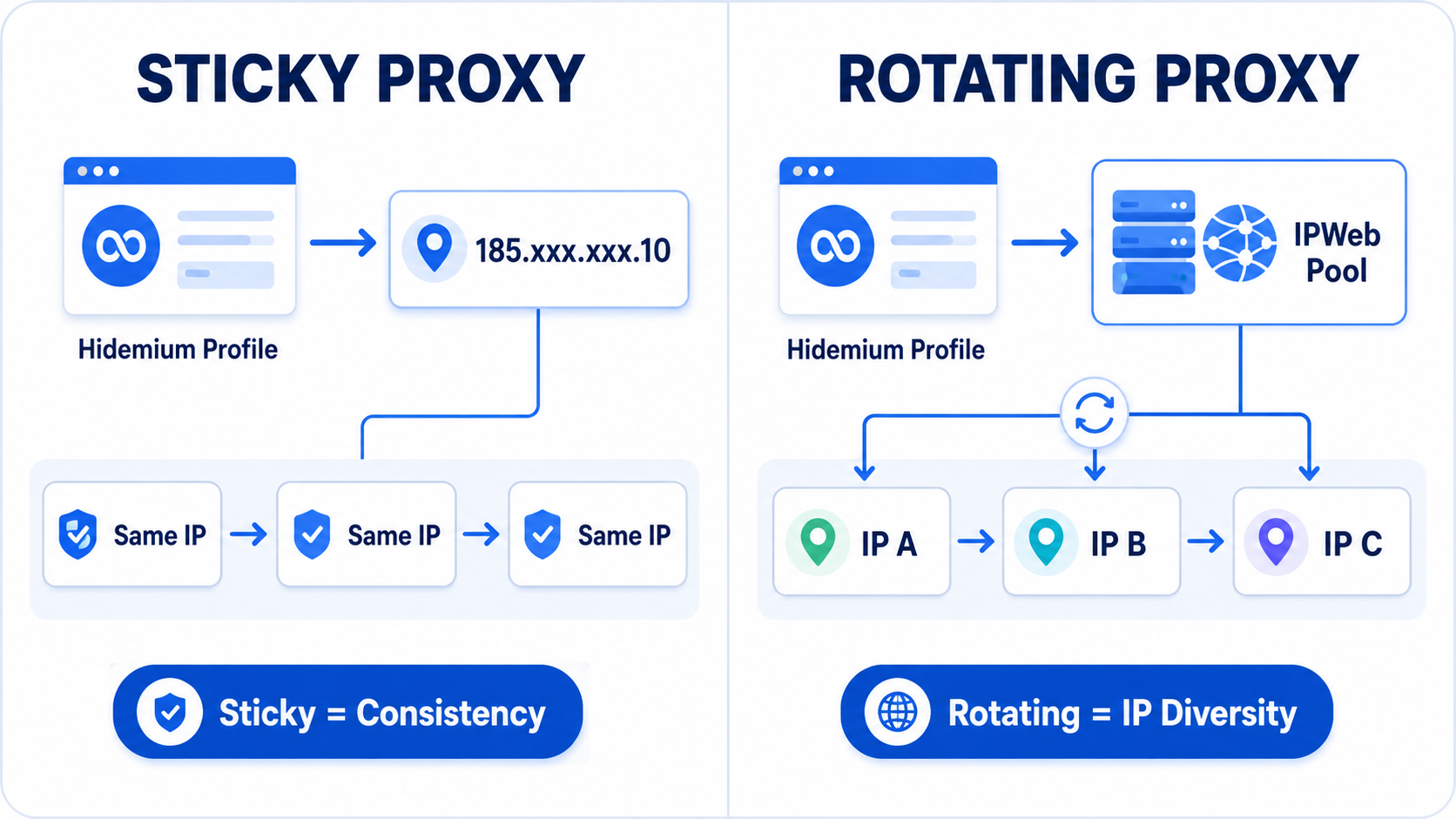
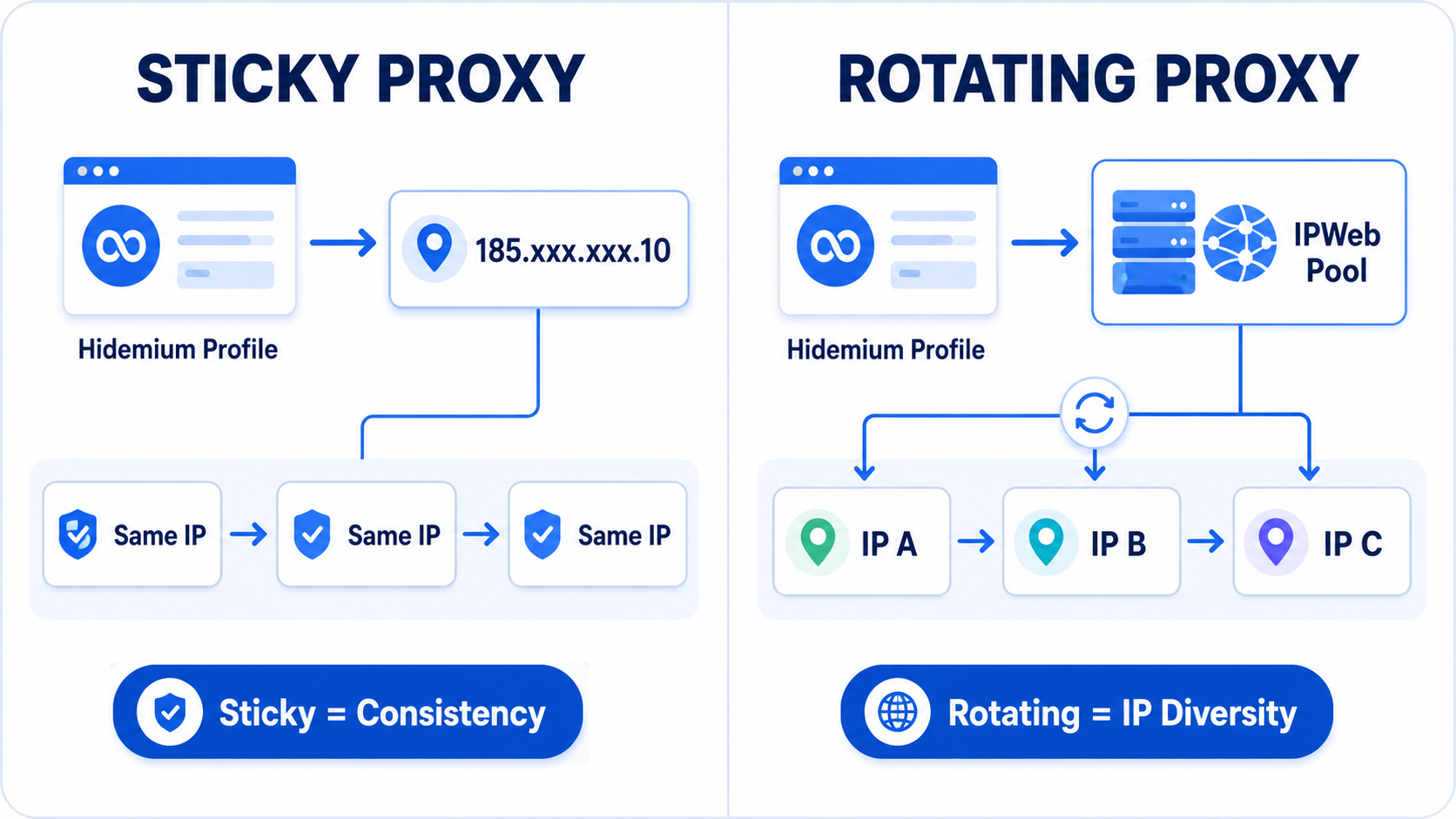
- Sticky proxy: keeps the same IP address for a defined session.
- Rotating proxy: automatically changes the exit IP over time or between connections.
For Hidemium users, sticky proxies are generally better when a browser profile needs a consistent network identity, while rotating proxies are more suitable for research, data collection and workflows that benefit from IP diversity.
This guide explains when to use each IPWeb proxy type with Hidemium and how to choose the right setup for your workflow.
Rotating vs Sticky Proxies: Quick Comparison
Feature | Sticky Proxy | Rotating Proxy |
| IP behavior | Same IP during a session | IP changes automatically |
| Session consistency | High | Lower |
| Best for | Long browser sessions | Research and repeated requests |
| Geo consistency | Easier to maintain | Depends on proxy pool |
| Hidemium use case | Persistent browser profiles | Research and automated workflows |
| Main advantage | Stable network identity | Larger IP diversity |
The most important question is:
Does your Hidemium profile need to keep the same IP throughout the session?
If yes, choose a sticky proxy.
If not, and your workflow benefits from accessing the web through multiple IP addresses, rotating proxies may be the better option.
When Should You Use a Sticky Proxy with Hidemium?
A sticky proxy keeps the same IP address for a specific period instead of changing it continuously.
This makes it a natural fit for Hidemium profiles that are designed to maintain a consistent browser environment.
A typical setup looks like:
Hidemium Profile → IPWeb Sticky Proxy → Website
Sticky proxies can be useful for:
- long browser sessions;
- localized website testing;
- e-commerce workflows;
- advertising and landing-page QA;
- region-specific browsing;
- environments where IP consistency matters.
Example
Suppose you create a Hidemium profile for testing how a website appears to visitors in the United States.
A logical configuration could be:
Browser profile: US environment
IPWeb proxy location: United States
Proxy mode: Sticky
Session: Persistent
Because the IP remains stable, the network location is less likely to change unexpectedly during the browsing session.
When sticky proxies make the most sense
Choose a sticky IPWeb proxy if your priority is:
Stable IP + stable Hidemium profile + consistent location
For session-based browser workflows, this is often the simplest configuration.
When Should You Use a Rotating Proxy with Hidemium?
A rotating proxy changes the exit IP automatically based on the proxy configuration.
Instead of relying on one IP for the entire session, your connection can use multiple addresses from a proxy pool.
This is useful when IP diversity is more important than maintaining one long network identity.
Typical use cases include:
- web research;
- public data collection;
- search result monitoring;
- localization research;
- website availability testing;
- approved automation workflows;
- accessing public information from different network locations.
A typical setup looks like:
Hidemium Profile → IPWeb Rotating Proxy Pool → Multiple IPs → Target Website
Hidemium continues to provide the isolated browser environment, while IPWeb handles the proxy routing and IP rotation.
When rotating proxies make the most sense
Choose a rotating IPWeb proxy if your priority is:
More IPs + broader geographic access + repeated web requests
For workflows that do not require a single persistent IP, rotation can offer more flexibility.
Sticky vs Rotating: Which Is Better for Hidemium?
Neither option is universally better.
The right proxy depends on what the Hidemium profile is being used for.
Choose Sticky Proxies If You Need:
- a stable IP during a browser session;
- consistent geo-location;
- a persistent profile-to-IP relationship;
- longer browsing sessions.
Choose Rotating Proxies If You Need:
- access to a larger proxy pool;
- different IP addresses over time;
- public web research;
- repeated data-access workflows;
- geo-distributed testing.
A simple rule is:
Need consistency? Choose sticky. Need IP diversity? Choose rotating.
Why Proxy Location Matters in Hidemium
Proxy type is only part of the configuration.
Proxy location also matters.
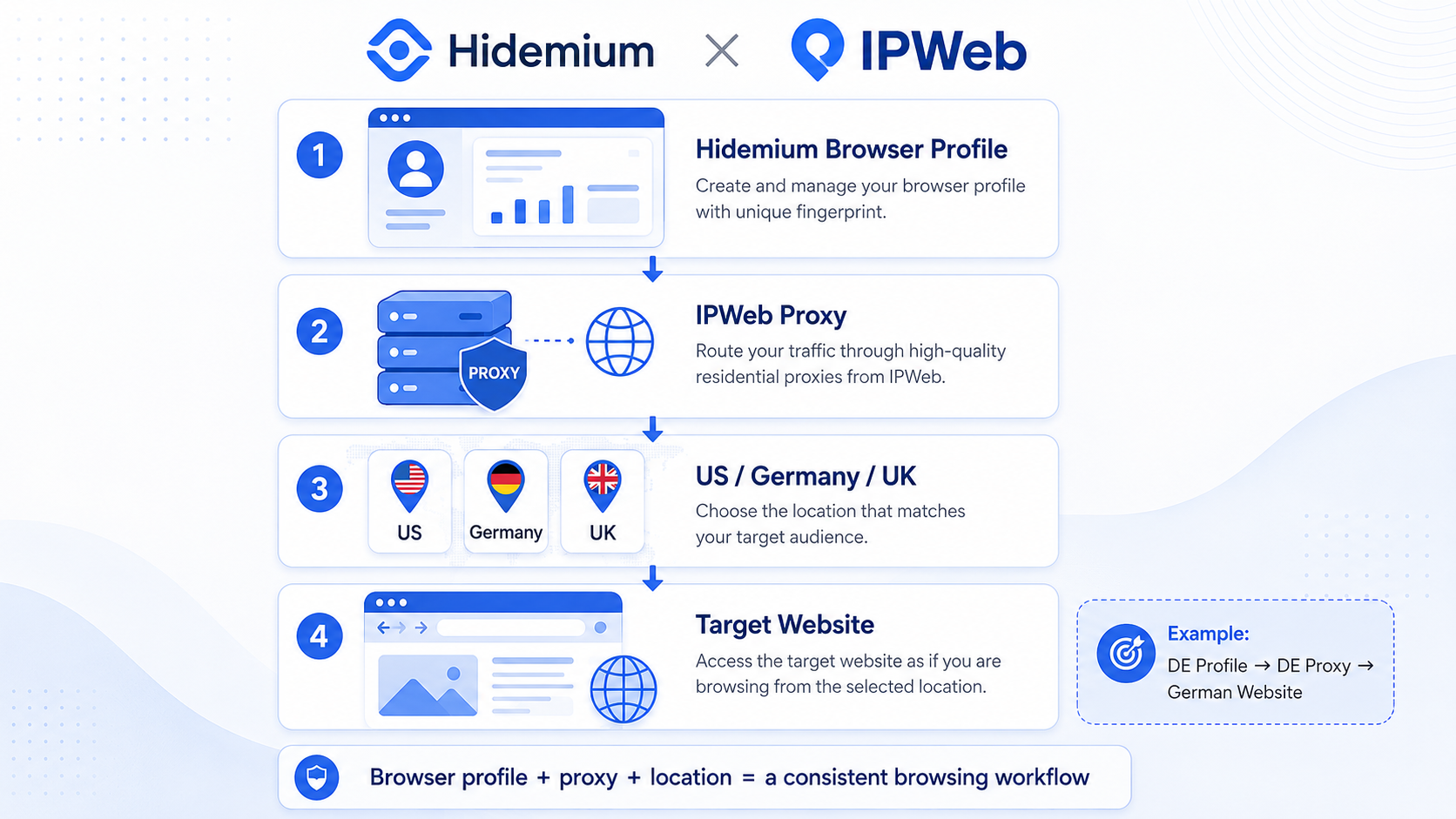
If your Hidemium profile is configured for a specific geographic workflow, the IP location should normally support that same use case.
For example:
Germany browser profile → Germany IPWeb proxy → German website version
or:
US browser profile → US IPWeb proxy → US search results
Keeping the browser environment and proxy location aligned creates a more predictable setup for localization, QA and market research.
Residential, ISP or Datacenter Proxy?
After deciding between sticky and rotating sessions, you may also need to choose the underlying proxy type.
Residential Proxies
Residential proxies use IP addresses associated with residential networks.
They can be useful when broad geographic coverage and residential IP availability are important.
ISP Proxies
ISP proxies can be suitable when you want a relatively stable IP connection while still using an ISP-associated network.
They can pair well with Hidemium profiles that require longer sessions.
Datacenter Proxies
Datacenter proxies are typically infrastructure-based and can be useful for workflows where speed and efficiency are more important than residential network characteristics.
The best option depends on your workflow.
Hidemium manages the browser environment. IPWeb manages the proxy connection.
That separation allows users to choose the proxy infrastructure that best matches each Hidemium profile.
Example Hidemium + IPWeb Setups
Here are three simple examples.
Example 1: Long-Term US Browser Session
Hidemium Profile: US Profile
IPWeb Proxy: US Sticky Proxy
Goal: Stable browsing session
Example 2: Localization Research
Hidemium Profile: Germany Research
IPWeb Proxy: Germany Sticky or Rotating Proxy
Goal: Check localized content and search results
Example 3: Public Web Research
Hidemium Profile: Research Profile
IPWeb Proxy: Rotating Proxy Pool
Goal: Work with multiple IP addresses during repeated research tasks
The ideal configuration is not determined by Hidemium alone. It depends on how the browser profile and proxy connection are expected to behave together.
How Hidemium and IPWeb Work Together
Hidemium and IPWeb solve different parts of the same workflow.
Hidemium Antidetect Browser provides isolated browser profiles and browser environment management.
IPWeb provides proxy infrastructure that determines how those profiles connect to the internet.
Together, the workflow becomes:
Browser Profile → Proxy Connection → Target Website
If you need a persistent network identity, use a sticky proxy.
If you need greater IP diversity, use a rotating proxy.
You can explore available proxy options at IPWebAI.com and connect the appropriate proxy configuration to Hidemium Antidetect Browser.
>>Read more : How to Configure IPWeb Proxies in Hidemium Antidetect Browser
Frequently Asked Questions
Is a sticky proxy better for Hidemium?
A sticky proxy is usually more suitable when a Hidemium browser profile needs to maintain the same IP address throughout a session.
Can I use rotating proxies with Hidemium?
Yes. Rotating proxies can be used when the proxy endpoint and protocol are compatible with the Hidemium proxy configuration.
Should every Hidemium profile use a different proxy?
Not necessarily, but separate proxy configurations can make different browser environments easier to organize when workflows require independent network identities.
Is residential or ISP proxy better for Hidemium?
It depends on the use case. Residential proxies can provide wider geographic coverage, while ISP proxies may be useful when longer and more stable sessions are preferred.
Which IPWeb proxy should I choose?
Use a sticky proxy when session consistency matters. Choose a rotating proxy when IP diversity and repeated web access are more important.
Related Blogs
.png)
In the digital age, protecting privacy and accessing geo-restricted content on Android has become essential. Using a free VPN is an effective solution to browse securely, bypass access restrictions, and protect personal data. Here’s the list of the top 10 free VPN apps for Android in 2025, rated based on speed, security, and user experience.1. What is a VPN and why do you need it on Android?A VPN[…]
.png)
Facebook Ads Library is an essential tool for advertisers looking to reach the right audience. It aggregates and displays all active ads on Facebook, making it easier for users to track and study campaigns. In this article, Antidetect Browser Hidemium will delve into Facebook Ads Library, its key features, and how to make the most of it to optimize your marketing strategy.1. What is Facebook Ads[…]

Have you ever felt tired eyes from constantly staring at the tiny phone screen to text? If so, you are not alone. With nearly 3 billion WhatsApp users worldwide, many of us are also looking for a more convenient solution.The good news is: WhatsApp Web is the perfect choice to help you get rid of that inconvenience. Now, you can chat on a large screen, type faster with a computer keyboard, and[…]
.png)
If you haven’t heard about OpenClaw yet, chances are you will soon.Since early 2026, this open-source AI agent has been gaining massive attention across communities, especially among marketers looking for smarter ways to automate their workflows. It promises something different from traditional tools — not just content generation, but actual task execution.But here’s the real question:Can[…]

IPFoxy TikTok Proxy Review: Performance and How to Test Them TikTok’s global reach demands reliable residential proxies to avoid IP hopping flags and boost local traffic. Yet most proxies fall short—data center IPs get blocked, cheap options risk contamination, and blacklisted IPs trigger bans.Now we test IPFoxy’s residential proxies and share a review and tutorial to dodge these risks.1. Why[…]

Snapchat has evolved far beyond a simple, ephemeral photo-sharing application. Today, it is a robust platform for communicating with close friends, consuming media, following creators, and even building brand awareness. But as your digital footprint expands, your needs change. You might suddenly find yourself wondering: can you have multiple snapchat accounts?Managing Multiple Snapchat Accounts:[…]
